
Expert AWS Cloud Consulting Services That Move Your Business Forward — Not Just Your Data.
AWS is the world’s most capable cloud platform. But capability without direction is just expensive infrastructure. Tech360’s AWS cloud consulting services help U.S. businesses plan, migrate, and operate on AWS the right way — secure, cost-controlled, and built to scale.
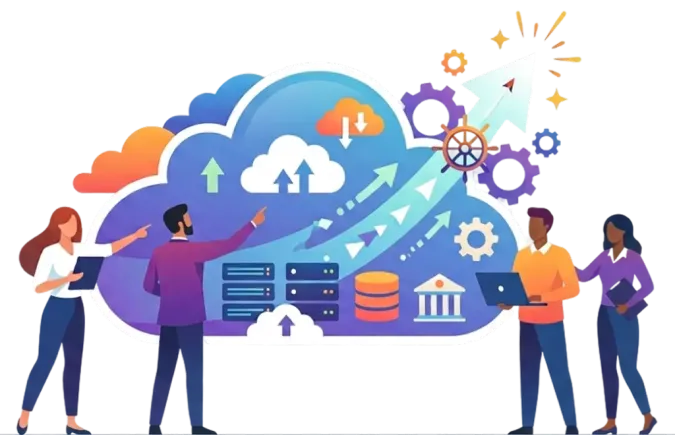

Why AWS Cloud Consulting Matters Now
AWS Is Powerful. That’s Exactly Why You Need Expert Guidance.
AWS offers more than 200 fully featured services — compute, storage, databases, networking, AI, security, analytics, and more. For a growing business, that breadth is a genuine advantage. It is also a very fast way to spend money on the wrong things, in the wrong configuration, without knowing it until the invoice arrives.
Most businesses that struggle on AWS did not make one catastrophic decision. They made a series of reasonable-looking small ones: an instance type chosen for convenience, a storage bucket configured with defaults, a development environment left running over a long weekend, a migration executed as a straight lift-and-shift because it was faster than redesigning first.
The problems compound quietly. By the time they surface — as an unexpected bill, a performance complaint, a compliance gap, or a failed audit — the cost of fixing them is substantially higher than the cost of getting them right from the start.
This is why AWS cloud consulting services exist. Not to add a layer of complexity between your business and the cloud, but to remove the ones that accumulate when experienced architecture and planning are absent.
The businesses getting the most from AWS — better performance, lower costs, stronger security, faster development — are not the ones with the biggest budgets. They are the ones that approached AWS as a strategic platform requiring deliberate design, not a utility to be activated and left alone.
Tech360 provides expert AWS cloud consulting services across the full lifecycle: from the initial architecture decision through migration, optimization, and ongoing managed operations. Whether you are evaluating AWS for the first time, dealing with a cloud environment that has grown beyond your visibility, or preparing to migrate a critical workload, the starting point is always the same — understanding your business first, and the technology second.
AWS Cloud Consulting Services: What we Deliver
Our AWS Cloud Services — Designed Around Your Business, Not a Checklist.
AWS Cloud Strategy and Architecture
AWS Cloud Migration Consulting Services
AWS Cloud Managed Services
AWS Security and Compliance
Cost Optimization and FinOps
AWS-Native Application Modernization
The Case for an Expert AWS Cloud SERVICES Provider
Getting on AWS Is Easy. Getting AWS Right Is a Different Problem.
AWS has made it remarkably simple to start. An account is active in minutes. A server is running in under an hour. A database is provisioned in less time than it takes to read the documentation.
This accessibility is a feature. It is also how organizations end up with sprawling, poorly documented, inconsistently secured environments that are genuinely difficult to understand, govern, or optimize.
The gap between “running on AWS” and “running AWS well” is an architecture gap, a governance gap, and an operational gap simultaneously. Closing all three requires depth that takes years to develop and is difficult to maintain with a small or generalist IT team.
As an expert AWS cloud services provider working with U.S. businesses, Tech360 brings that depth to each engagement — not as a vendor relationship with AWS, but as a partner relationship with the businesses we work with. Our only interest is in an AWS environment that performs the way your business needs it to, costs what it should, and does not become a liability when the pressure is on.

The Future of AWS Cloud Services
What AWS Is Becoming — and Why It Matters for Your Business:

AI and Machine Learning as Standard Infrastructure
AWS services like Amazon Bedrock, SageMaker, and Rekognition are bringing AI capability within reach of businesses that previously needed dedicated data science teams to access it. Within the next two years, AI-assisted analytics, automated decision support, and intelligent automation will move from advanced features to standard components of a well-architected AWS environment.
Security Automation at Scale
AWS is investing heavily in automated security tooling — threat detection, misconfiguration alerting, automated remediation, and compliance validation that runs continuously rather than periodically. The businesses that benefit most from this direction are the ones with properly structured environments where automation has clear boundaries to operate within.
Serverless as the Default Compute Model
The shift from managing servers — even virtual ones — to event-driven, function-based compute is accelerating. AWS Lambda and the broader serverless ecosystem let development teams focus on business logic rather than infrastructure management. For growing SMBs, this means faster development cycles, automatic scaling, and a billing model that charges only for actual execution — not idle capacity.
Multi-Region and Edge Architectures
As latency requirements tighten and data sovereignty regulations expand, multi-region AWS architectures and edge computing through AWS Outposts and Local Zones are becoming relevant for a broader range of businesses. Designing for this from the start is significantly more straightforward than retrofitting it onto a single-region architecture later.
FinOps as an Engineering Discipline
Cloud cost management is moving from a finance function to an engineering one. AWS is building cost visibility and optimization tooling directly into its developer experience, and the expectation is shifting toward engineering teams owning their cloud spend as a first-class responsibility, not receiving a monthly report about it.
Sustainability Metrics in Cloud Planning
AWS now provides carbon footprint data by service and region. As environmental reporting requirements expand, the ability to measure, report, and optimize the carbon impact of cloud operations is becoming a real business consideration — not just a marketing one.
Challenges in AWS Cloud Consulting Services in USA
The Real Obstacles SMBs Face When Moving to AWS — Honestly Addressed.
Complexity That Scales Faster Than Expertise
Cost Visibility That Arrives Too Late
Security Misconfiguration as the Leading Cause of Incidents
Migration Scope Underestimation
Skills Gaps That Widen as the Environment Grows
Vendor Lock-In Concerns
Compliance in a Shared Responsibility Model
Evolving Physical Threats
The challenges above are real, but none of them are novel. Every one of them has a known solution — architecture, governance, tooling, or process — that experienced AWS cloud consulting services practitioners have implemented before. The risk is not AWS. The risk is running AWS without the expertise to navigate it.
The Tech360 Difference: Expert AWS Cloud Consulting Services in USA

Every AWS engagement starts with understanding the business — its goals, constraints, compliance obligations, and growth trajectory. The technology architecture follows from that understanding, not the other way around. We do not recommend services because they are new or impressive; we recommend them because they fit.
Business-first, not technology-first.
It is relatively straightforward to get a workload running on AWS. The harder design problem is ensuring it remains maintainable, secure, and cost-efficient as the team, the codebase, and the business scale. We design for the 18-month picture, not the launch milestone.
Architecture that accounts for day two, not just day one
Identity design, network segmentation, encryption, and compliance controls are part of the architecture from the first design session. They are not a separate workstream added after the core build is complete.
Security embedded, not appended
Tagging strategy, budget alerts, rightsizing cadence, and FinOps reporting are established during the migration phase — not after the first unexpected bill triggers the conversation.
Cost accountability from the start
We remain accountable for the environments we design and build. Our aws cloud managed services practice means the businesses we work with have a partner who knows their environment and is reachable when something goes wrong — not a completed project file.
Ongoing managed partnership, not a handoff
Our Approach to AWS Cloud Consulting
Discovery and Assessment
We begin with a structured review of your current infrastructure, application portfolio, compliance requirements, and business objectives. For existing AWS environments, this includes a spend analysis, a security posture review, and an architecture gap assessment. For businesses new to AWS, it means defining the requirements that will drive the architecture design.
Architecture Design
We design the AWS environment around your specific requirements: account structure, network design, identity and access model, security baseline, data architecture, and the migration or build sequence. The design is documented with explicit tradeoffs, not just a diagram.
Migration or Build Execution
We execute against the architecture. For migrations, this means wave-based delivery with validation gates at each stage and a tested rollback procedure for every critical system. For new builds, it means production-quality infrastructure from the first deployment, with CI/CD pipelines, observability, and IaC in place before the first user touches the product.
Security and Compliance Validation
Before any environment goes live at scale, we validate the security configuration against the relevant compliance framework — HIPAA, PCI DSS, SOC 2, or CMMC — and remediate any gaps identified.
Optimization and Managed Operations
Post-launch, our AWS cloud managed services team takes over ongoing operations — monitoring, incident response, patching, FinOps, and continuous optimization as usage patterns evolve and new AWS capabilities become relevant to the business.
FAQs - AWS Cloud Consulting Services
Frequently Asked Questions
What do AWS cloud consulting services actually include?
WS cloud consulting services cover the full range of advisory, architecture, implementation, and managed operations work associated with planning and running workloads on Amazon Web Services. This includes defining the right AWS architecture for a specific business, planning and executing migrations, configuring security and compliance controls, optimizing cloud costs, and providing ongoing operational management. The scope varies by engagement — some businesses need architecture guidance only, others need full end-to-end delivery and managed operations.
How much do AWS cloud consulting services cost?
Costs vary significantly based on scope. A focused architecture review or migration assessment for an SMB might range from a few thousand dollars. A full migration and managed services engagement covering multiple workloads is a longer-term investment. The more useful framing for most businesses is the total cost of not getting it right — the wasted spend, security incidents, and rework that result from AWS environments that were not properly designed. Tech360 provides transparent cost estimates at the conclusion of the discovery phase, before any implementation work begins.
How long does an AWS cloud migration take?
For a typical SMB with 5 to 15 workloads, a well-planned migration takes 8 to 16 weeks from kickoff to final cutover. The timeline depends on the complexity of the workloads, the depth of dependency mapping required, and whether any workloads need re-platforming rather than rehosting. Migrations that are rushed without proper discovery consistently take longer in total — the time saved upfront is recovered several times over in incident management and rework.
What is the difference between AWS cloud consulting and AWS cloud managed services?
Consulting is advisory and project-based — it covers strategy, architecture, and implementation. Managed services is ongoing — it covers the day-to-day operations of your AWS environment after implementation is complete. Many businesses need both: consulting to design and build the environment correctly, and managed services to operate it reliably and cost-efficiently over time. Tech360 provides both, with continuity between the team that designs the environment and the team that operates it.
Is AWS the right cloud platform for my business?
How do you keep AWS costs under control?
Cost control on AWS requires four things working together: tagging that attributes every dollar to the team, application, and environment that generated it; alerting that surfaces cost anomalies in near-real time rather than in the monthly invoice; rightsizing that continuously matches instance types to actual utilization rather than peak estimates; and commitment coverage through Reserved Instances or Savings Plans for the stable portion of the workload. Most businesses that engage our AWS cloud managed services practice recover 20 to 35 percent of their existing cloud spend within the first 90 days.
What does "shared responsibility" mean in AWS security?
AWS secures the physical infrastructure — the data centers, the networking hardware, and the underlying hypervisor. Everything running on that infrastructure is the customer’s responsibility: the operating system configuration, the application, the access policies, the network settings, and the data. Many cloud security incidents result from customers assuming AWS has configured their environment securely by default. It has not — the default configuration is a starting point, not a finished security posture. Our AWS cloud consulting practice designs security into the environment explicitly, not assuming it is inherited from the platform.
Why choose Tech360 as an AWS cloud services provider over a larger consulting firm?
Larger firms bring deep benches and broad brand recognition. They also bring account teams whose incentive is to expand the engagement regardless of whether expansion serves the client. Tech360 works with a focused client base and maintains genuine continuity between the team that designs your environment and the team that operates it. The architects who define your AWS strategy are reachable when something unexpected happens — not replaced by a support queue. For SMBs in the US that need expertise without enterprise-scale overhead, that continuity and accountability is often the deciding factor.

Success Stories
Success Beyond Code!


“From Sticky Notes to 100% Seamless Operations”
A regional retailer wanted to “go digital” but was drowning in legacy systems and paper-heavy processes. Tech360 stepped in with digital transformation services that modernized their operations end-to-end — cloud migration, workflow automation, and real-time analytics. Within 6 months, they cut manual tasks by 40%, launched an online storefront, and doubled customer engagement. The CEO put it best: “We used to survive on sticky notes and gut instinct. Now we actually know what’s happening, and customers notice.” Transformation doesn’t always start flashy; sometimes it’s just about finally getting the basics right.
“From Prototype Struggles to Market Success”
A fast-growing startup had an idea for a healthcare app but kept stalling after failed MVP attempts. Tech360’s product engineering services guided them from concept to launch: ideation, prototype, testing, and full-scale development. We built a secure, scalable app that integrated seamlessly with medical devices, all while meeting HIPAA standards. The result? A product that hit the market three months early and attracted a major investor round. That’s the power of structured software product engineering: clarity from day one.
“Turning Salesforce into a Sales Engine”
A mid-sized B2B company had Salesforce but treated it like an expensive Rolodex! Sales reps hated it, managers ignored it, and data lived everywhere but there. Tech360 brought in Salesforce development services and a certified team to customize workflows, integrate third-party systems, and build dashboards that actually answered business questions. Within weeks, sales adoption skyrocketed, reporting accuracy improved by 60%, and quarterly revenue jumped. The client admitted, “We finally feel like Salesforce is working for us, and not the other way around.”
Your AWS Environment Should Be Working for Your Business. Let's Make Sure It Is.
Whether you are evaluating AWS for the first time, dealing with an environment that has grown beyond your visibility, or looking for a partner to manage it properly — the conversation starts with understanding your business, not pitching a platform.